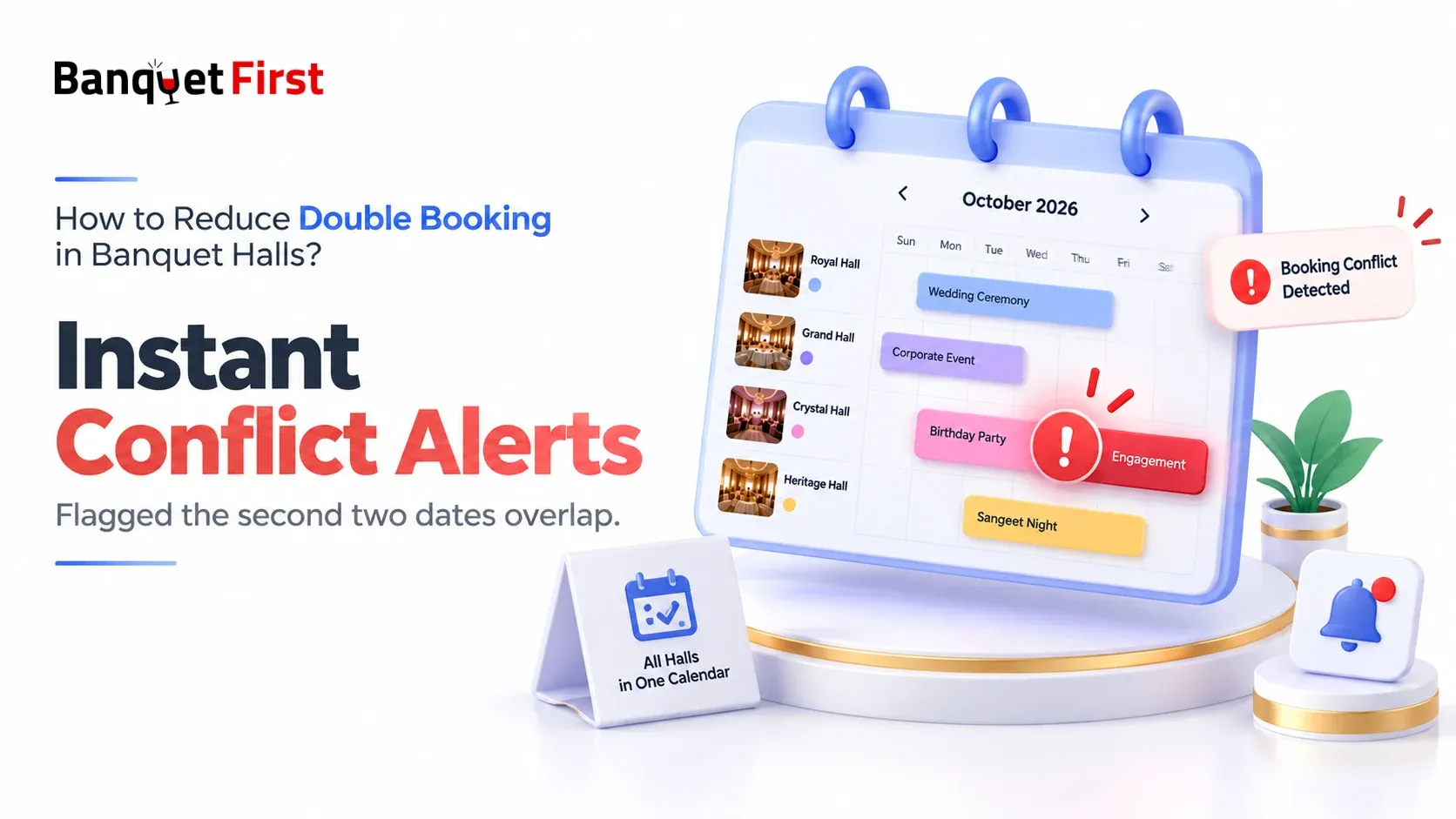
To reduce double booking in banquet halls, replace manual registers with one real-time booking calendar that shows every hall's live availability, block confirmed and tentative dates instantly, sync updates across all teams, and record cancellations in the same place. Centralized banquet software like BanquetFirst prevents these conflicts automatically before they ever reach a guest.
What Is Double Booking in Banquet Halls?
Double booking happens when the same hall or event space gets confirmed for two different clients on the same date and time slot. In a banquet business, this usually means two weddings, receptions, or corporate functions land on one venue, and only one of them can actually take place.
Put simply: a double booking is any scheduling conflict where a single venue resource, such as a hall, lawn, or banquet space, is committed to more than one event for an overlapping date or time.
The issue looks minor on paper. In practice, one double booking can cost a venue an entire event's revenue, plus refunds, last minute compensation, and lasting reputation damage. That is why strong double booking prevention is one of the first systems fast growing venues put in place.
Here is a real example many venue owners recognize. A booking calendar shows a Friday and Saturday already marked with a confirmed event. If that same slot gets confirmed again by a second salesperson, you now have two clients holding the same date. Good banquet software stops this at the source: once a date is booked, the system shows it as unavailable, so no one can confirm it twice.
Why Does Double Booking Happen in Event Venues?
Most double bookings are not caused by carelessness. They are caused by fragmented information. When availability lives in different places, teams end up working from different versions of the truth.
Common reasons double booking happens in event venues:
- Manual registers and spreadsheets. Separate files or diaries for each hall make it hard to see full availability at a glance.
- Multiple sales channels. Enquiries arrive through calls, WhatsApp, walk ins, referrals, and online forms, and not all get logged in one system.
- Delayed updates. A date gets confirmed in the evening but recorded the next day, leaving a window where it still looks open.
- Untracked tentative holds. A client asks to hold a date, but the hold is never written down, so the slot appears free to everyone else.
- Poor team visibility. The sales team, front desk, and operations team each keep their own notes instead of a shared live view.
The tentative hold blind spot
Here is an insight most venues miss. The majority of double bookings do not come from two confirmed events clashing. They come from tentative holds that were never recorded. A client verbally reserves a Saturday, the salesperson remembers it but does not log it, and a second team member confirms a paying event for the same day. The fix is treating every hold as a visible entry in the calendar, not a mental note.
Why Reducing Double Booking Matters for Your Venue
A double booking is not just an operational hiccup. It creates a chain of damage that touches revenue, trust, and team morale.
When two events collide on one date, the consequences add up quickly:
- Lost revenue. You either lose one full booking or scramble to accommodate both, often at extra cost.
- Damaged reputation. Weddings and milestone events are emotional. A cancelled or shifted event spreads fast through word of mouth and reviews.
- Refunds and compensation. You may have to return advances and offer discounts to keep goodwill.
- Team stress. Staff spend hours firefighting instead of closing new business.
There is a second insight worth stating clearly. Double booking is a symptom, not the root problem. The root problem is that your teams are working from separate records. Solve the single source of truth, and double booking prevention becomes automatic rather than a daily worry.
How to Reduce Double Booking in Banquet Halls: 7 Proven Strategies
The most reliable way to reduce double booking in banquet halls is to centralize availability and standardize how dates get confirmed. These banquet hall double booking prevention strategies work whether you run one hall or several.
- Move to a single real-time booking calendar. Every hall, lawn, and space should appear on one screen with live availability, so any team member sees the same picture at the same moment.
- Record tentative holds, not just confirmed bookings. Log every verbal or provisional hold as a visible entry so the date shows as reserved to everyone.
- Block unavailable dates immediately. Maintenance days, private functions, and off dates should be blocked in advance so no one offers them by mistake.
- Give every team one shared source of truth. Sales, front desk, and operations must all work from the same live calendar instead of personal notes.
- Update cancellations and postponements the same day. When a booking is cancelled or moved, update it instantly so the freed date becomes bookable again and no slot stays wrongly blocked.
- Set clear booking confirmation rules. Define who can confirm a date, what counts as confirmed, and how advances lock a slot, so two people never confirm the same day.
- Review the calendar daily before confirming new dates. A quick daily check before any new confirmation catches conflicts early, especially during peak wedding season.
Applied together, these steps turn double booking from a recurring risk into a rare exception.
How to Prevent Double Bookings in Event Venues With Software?
Manual discipline helps, but people forget and channels multiply. Software is what makes double booking prevention consistent. Purpose built banquet management software prevents double bookings in event venues by keeping availability accurate in real time and blocking conflicts before they happen.
Here is how the right platform closes the gaps:
- Real-time booking calendar. All bookings across every hall appear on one centralized calendar that updates instantly for the whole team.
- Venue holds. Tentative bookings can be held so everyone knows a date is temporarily reserved and not open for sale.
- Date blocking. Unavailable dates can be blocked ahead of time, removing them from the pool of bookable slots.
- Automatic conflict prevention. The system is designed to flag and stop overlapping bookings, so a taken date cannot be confirmed twice.
- Cancellation and postponement management. Cancelled or postponed events update in the same system, keeping availability correct at all times.
- Multiple hall management. Several halls and spaces are managed from one view, which is where manual methods usually break down.
The practical result is simple. If a date already holds an event, the calendar marks that slot as taken, and the next team member sees it is unavailable before ever offering it to a new client.
Manual Registers vs Banquet Software: Which Prevents Double Booking Better?
Many venues start with a register or a shared spreadsheet. It works until enquiries grow and multiple halls are in play. The comparison below shows why software wins on double booking prevention.
| Factor | Manual Registers and Excel | Banquet Software (BanquetFirst) |
|---|---|---|
| Availability view | Separate file per hall | All halls on one real-time calendar |
| Update speed | Manual and often delayed | Instant with live sync |
| Tentative holds | Easy to forget | Recorded as visible venue holds |
| Conflict alerts | None | Conflicts prevented automatically |
| Cancellations | Updated late or missed | Updated in the same system |
| Team access | One person, one file | Shared live view for all teams |
| Multiple halls | Hard to track together | Managed from a single screen |
The takeaway is clear. Manual methods depend on memory and timing. Software removes both variables, which is exactly why it reduces double booking so effectively.
How BanquetFirst Helps Reduce Double Booking in Banquet Halls
BanquetFirst is an AI powered banquet management software built for hotels, banquet halls, resorts, and event venues across India. It solves double booking through a centralized, real-time booking system that keeps every team on the same live availability view.
With BanquetFirst, you can see all bookings across every hall in real time, block dates, handle cancellations, and prevent conflicts without spreadsheets. Its venue management tools are purpose built for this exact problem, including a real-time booking calendar, venue holds, date blocking, postpone and cancel booking workflows, and automatic prevention of double bookings.
Because sales and operations teams share one live calendar, the risk of confirming an already booked date drops sharply. The moment a slot is booked, it shows as unavailable to everyone, so no second confirmation slips through.
BanquetFirst also connects booking management with the rest of your venue operations. Leads, WhatsApp automation, digital quotations, payments, guest profiles, and daily reports live in one platform, so a booking confirmed anywhere reflects everywhere. Built by an ISO 27001 certified company and an official Meta WhatsApp Partner, and trusted by more than 500 venues, it is designed for teams that cannot afford booking mistakes.
If you want to stop double bookings for good, you can start a free trial of BanquetFirst with no credit card required, or book a live demo to see the booking calendar in action. The team operates out of New Delhi and supports venues nationwide.
Conclusion
Learning how to reduce double booking in banquet halls comes down to one principle: keep every hall's availability in a single real-time source that your whole team trusts. Record tentative holds, block unavailable dates, update cancellations promptly, and standardize how bookings get confirmed. Manual registers leave gaps that memory and timing cannot close, while purpose built software prevents conflicts automatically. Platforms like BanquetFirst bring bookings, holds, and cancellations into one live calendar, so a taken date can never be confirmed twice and your revenue stays protected.
Frequently Asked Questions
What causes double booking in banquet halls? Double booking is usually caused by fragmented records: separate files per hall, delayed updates, enquiries from many channels, and untracked tentative holds. When teams work from different versions of availability, the same date can be confirmed twice.
How does banquet software prevent double booking? Banquet software keeps all halls on one real-time calendar, records holds, blocks unavailable dates, and updates cancellations instantly. Once a date is booked, it shows as unavailable to everyone, so overlapping bookings are prevented before they happen.
Can double booking be prevented without software? Partly. Clear confirmation rules, logged holds, and daily calendar reviews reduce the risk. But manual methods depend on memory and timing, so gaps remain. Software removes both variables and makes double booking prevention consistent across teams.
What is the best software to reduce double booking in banquet halls near me? BanquetFirst is a strong option for venues in India looking to reduce double booking. It offers a real-time booking calendar, venue holds, date blocking, and automatic conflict prevention, all managed from one screen with a free trial available.
How do venue holds reduce double bookings? Venue holds record tentative reservations as visible calendar entries, so a date under discussion is not offered to another client. This closes the tentative hold blind spot, which is a common and often overlooked cause of double bookings.